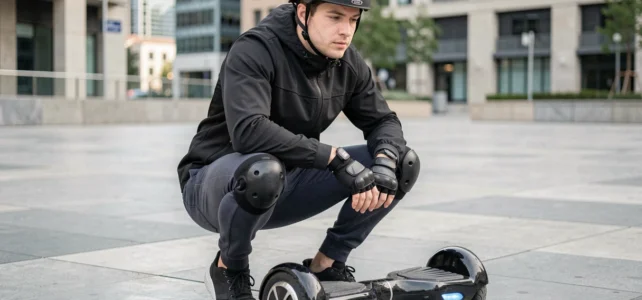
A hoverboard operates thanks to two brushless motors integrated into each wheel, powered by a lithium-ion battery and controlled by a gyroscope that translates weight shifts into speed and direction commands. Improving the performance of this system, whether in terms of autonomy, responsiveness, or top speed, involves acting on three components: the battery, the controller firmware, and the tires. Each modification directly impacts the safety of the device.
BMS and controller firmware: what really limits the speed of a hoverboard
The BMS (Battery Management System) is the electronic circuit that monitors the voltage of each lithium-ion cell, cuts power in case of overheating, and regulates the discharge current. It sets the power ceiling available for the motors, not the raw capacity of the battery.
The controller (the motherboard of the hoverboard) receives data from the gyroscope and the BMS, then calculates the current sent to each motor. Its firmware contains software limits: maximum speed, allowed tilt angle, peak current. These parameters are factory calibrated to meet the safety certification thresholds of the model.
Modifying the firmware to push these limits increases torque and speed but partially disables thermal and electrical protections. The BMS may then allow a current higher than what the cells can tolerate, accelerating their degradation and increasing the risk of thermal runaway.
Before making any changes to the firmware, it is essential to know how to unlock a hoverboard with Speeder to understand the modifiable parameters and their consequences on system stability.
UL 2272 certification and compliance: the limit not to be crossed
The UL 2272 standard covers the entire electrical system of a hoverboard: battery, charger, wiring, controller. It imposes tests for overload, short circuit, thermal shock, and drop. The complementary UL 2271 standard specifically applies to replaceable batteries.
In the United States, the CPSC published a proposed federal rule in June 2026 aimed at making these two standards legally mandatory for all micromobility devices, including hoverboards, their replacement batteries, and their chargers. Several major retailers (Amazon, Walmart, Target) already require UL 2272 certification to list a hoverboard.
Any hardware modification that alters the BMS or charging circuit voids this certification. Replacing a battery with a higher capacity unapproved model, soldering a different connector, or flashing third-party firmware amounts to riding with a device that no longer meets the original safety requirements.
In practice, viable performance gains remain those that do not affect the electrical circuit protected by certification: tire pressure, mechanical maintenance, and management of charge cycles.
Battery maintenance and charge cycles to gain autonomy
The actual capacity of a lithium-ion battery decreases over time, but the speed of this degradation directly depends on charging habits. Three practices extend the useful life and maintain the original autonomy.
- Avoid systematic full charging to 100%. Unplug the hoverboard when the indicator turns green, without leaving it charging overnight. Prolonged charging beyond the maximum threshold stresses the cells and accelerates capacity loss.
- Avoid regularly discharging below the last few percent of battery. Repeated deep discharges reduce the number of usable cycles. Recharge as soon as the indicator signals a low level.
- Store the hoverboard at room temperature, away from direct heat sources. Lithium-ion degrades faster above 40 °C, even when not in use.
These actions do not modify any electronic components. They preserve the battery’s capacity, resulting in a longer distance traveled and sustained motor power over time.
Use the right charger
The original charger is calibrated to deliver the voltage and current specified by the manufacturer. A generic charger with a different voltage can force an unsuitable current into the cells, cause the BMS to overheat, or damage the connector. Replacing a faulty charger with a certified model of the same voltage remains the only safe option.
Tires, pressure, and equipment: the mechanical levers of performance
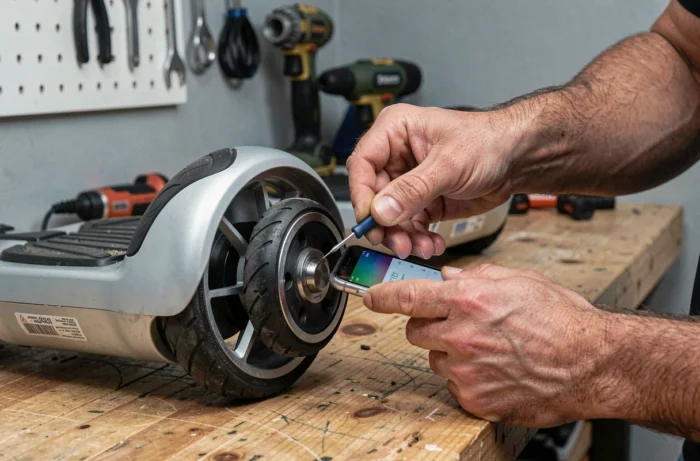
On a hoverboard with inflatable tires, the inflation pressure directly influences the perceived speed and energy consumption. An under-inflated tire increases the contact surface with the ground, creates higher rolling resistance, and forces the motors to consume more to maintain the same pace.
Checking the pressure before each outing and maintaining it at the level indicated by the manufacturer improves responsiveness and reduces battery strain. On solid wheel models, the action lever is more limited: cleaning the bearings and removing debris stuck in the wheels is enough to avoid unnecessary friction.
Safety equipment and posture
Gaining speed without wearing a helmet, wrist guards, and knee pads turns a performance gain into an increased risk of injury. In the UK, injuries to children related to micromobility devices have significantly increased in recent years, leading several cities to strengthen usage regulations.
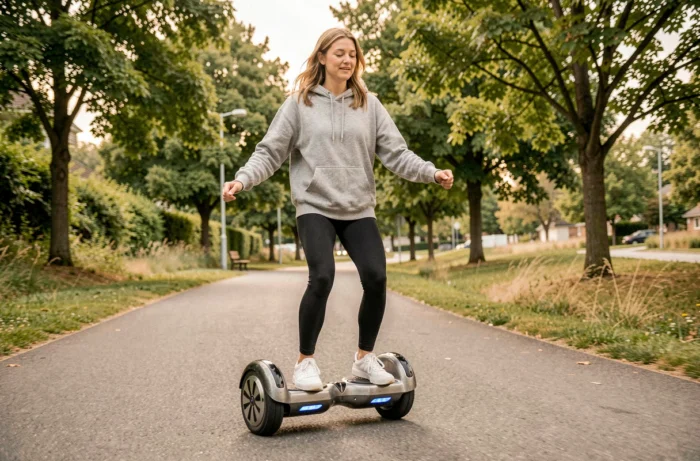
The posture on the platform conditions stability as much as the mechanics. Feet shoulder-width apart, knees slightly bent, looking straight ahead: this position lowers the center of gravity and allows the gyroscope to better interpret micro-adjustments in weight.
The most sustainable performance gain on a hoverboard comes from regular maintenance of the battery and tires, not from modifying the electrical circuit. As long as UL 2272 and UL 2271 standards govern the design of devices, the safe optimization margins remain mechanical and behavioral.