A rainy afternoon, a pedagogical day, or simply the desire to spend time together: there are plenty of opportunities to look for fun and educational activities at home. Rather than piling up ideas without a guiding thread, it’s better to focus on a few formats that really work, tailored to the ages present under your roof and the materials already available.
Replace screen time with hands-on activities
The decree of June 27, 2025, now prohibits exposing children under 3 years old to smartphones, tablets, computers, and televisions in French childcare facilities. At home, this logic easily translates.
Recent recommendations are no longer limited to a time count. They emphasize the balance between sleep, free play, and interactions with an adult. Four time slots are identified as sensitive for 3-6 year-olds: morning upon waking, mealtimes, the bedroom, and the time before bedtime.
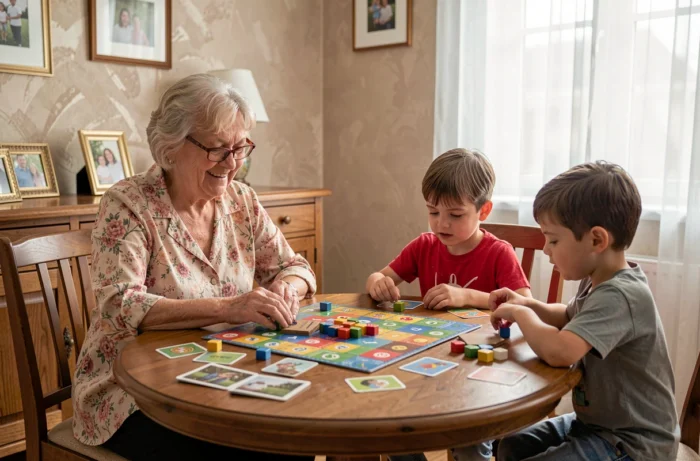
Specifically, each time slot can accommodate a short activity. In the morning, a puzzle or a building game. During meals, a riddle or a small oral quiz. In the evening, a shared reading. This division by moments of the day, rather than by theme, makes the transition more natural for the whole family. Catalogs of ideas classified by age and duration are available on letsplayfamily.fr, which avoids having to search for inspiration each time.
Paper games and homemade dough: the materials you already have
Have you noticed that the simplest activities often captivate the longest? Paper, flour, salt, and water are enough to keep a group of children occupied for over an hour.
Making homemade playdough
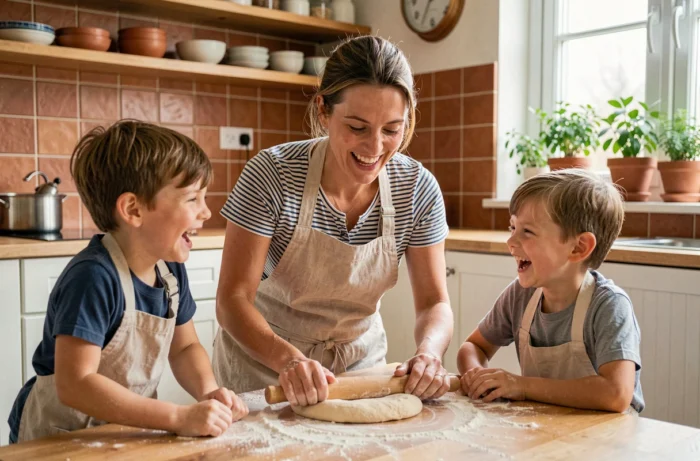
Mix one cup of flour, half a cup of fine salt, one cup of warm water, and a tablespoon of vegetable oil. The making itself is the activity: measuring, pouring, mixing, kneading. The youngest work on their fine motor skills, while the older ones can add food coloring and observe the color mixtures.
The resulting dough can be stored for several days in plastic wrap in the refrigerator. Each evening, the children can revisit their creations or invent new ones.
Origami and cutting for older children
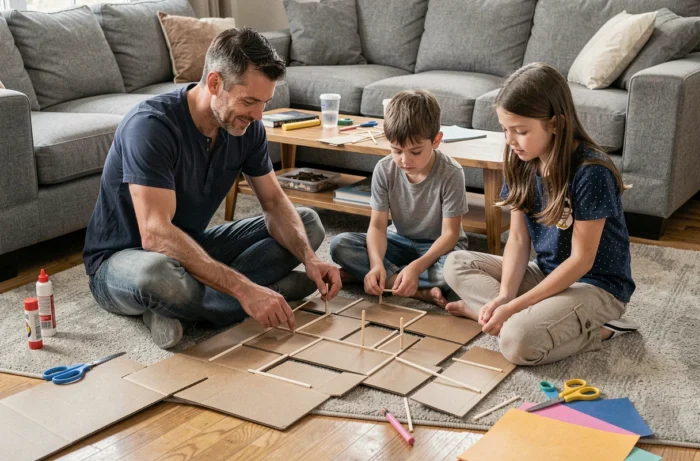
From ages 6-7, paper folding introduces geometry without naming it. A square becomes a boat, then a crane, then a box. Each fold requires precision. The child learns symmetry through action before understanding it through words.
Keep a stack of scrap paper handy. Recycled paper works just as well as colored paper, and children are less hesitant to start over when the material costs nothing.
Treasure hunt in the living room: transforming familiar space
The treasure hunt remains one of the most versatile formats for family play at home. It adapts to all ages as long as the type of clues varies.
- For ages 3-5: visual clues (photos of household objects, drawings, colored stickers to follow). Five steps are enough, as attention spans are short.
- For ages 6-9: written riddles, small calculations whose result indicates a page number in a book, or rebuses made with pictures cut out from magazines.
- For ages 10 and up: a home escape game scenario, with combination locks, coded messages (Caesar cipher, reversed alphabet), and a time limit.
The parent preparing the treasure hunt works just as much as the children solving it. Count on about twenty minutes of preparation for a five-step hunt. The time invested / playtime ratio is very favorable.
Family yoga and body games without equipment
Indoor physical activities are not limited to running in the hallway. Child-friendly yoga offers poses with animal names: the tree, the cat, the cobra. The child imitates, holds the pose for a few seconds, then moves on to the next.
You can turn a yoga session into a memory game. Each person adds a pose in sequence. The first one to forget a step starts over. The body becomes the medium for learning, not a notebook or a screen.
For families with children of varying ages, mime games work particularly well. A 4-year-old mimes an animal, a teenager mimes a profession or a movie. Everyone participates at their level without needing to separate the groups.
Adapting intensity to available space
In a small apartment, prioritize static or low-amplitude games: mime, yoga, statue game. In a house with a hallway or accessible garden, the treasure hunt or obstacle course (cushions, chairs, blankets) allows for more energy expenditure.
- Small space: yoga, mime, blindfold game (guessing an object by touch)
- Medium space: motor course with cushions and chairs, dance with musical stops
- Large space: treasure hunt across multiple rooms, home escape game with movement
The successful activity is one that takes into account the actual space, not an ideal home with a playroom.
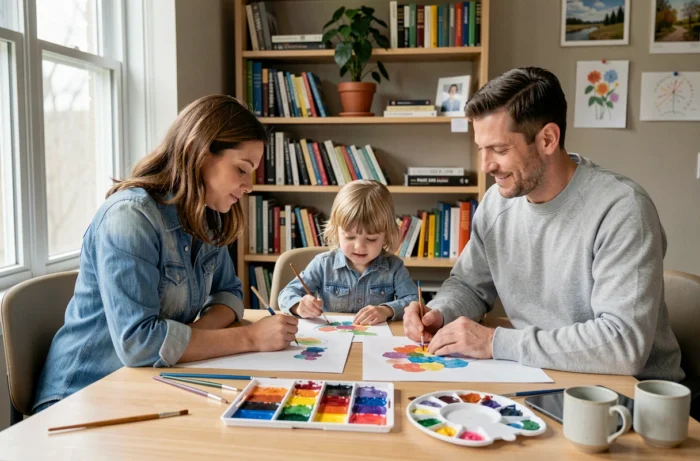
The common thread of all these proposals is based on one principle: start with what you already have (paper, flour, cushions, your own body) rather than buying additional materials. Children rarely remember the medium used. They remember the shared moment, the challenge overcome together, the laughter from a failed mime. It’s this memory that makes them want to do it again the following weekend.