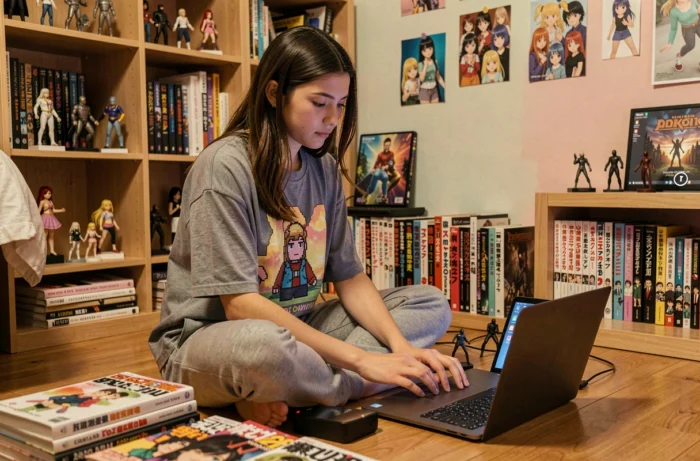
Women account for around 24% of the video game workforce in France, according to a report published in January 2025. This figure, which has remained stable for several years, reveals a structural gap: the share of women who play games in the general population far exceeds the share of women working as creators, developers, or art directors.
Geek culture for women is about more than consuming content. It raises questions about who makes it, who moderates it, and who sets the rules for online community spaces.
Video game platform moderation: a barrier for women gamers
Reporting tools built into multiplayer games do not treat gender-based harassment as a distinct category. Most moderation systems rely on automated keyword detection or manual reports filed after an incident. This reactive approach lets hostile behavior slip through when it does not involve explicit insults: systematically excluding someone from a team, targeted sabotage, or sexualized remarks in voice chat.
Belgian collectives such as WitchGamez and Pixielles, profiled by Soralia, have drawn attention to this shortcoming. Their findings echo those of many French-speaking women gamers: publishers shift the burden of proof onto victims without providing automatic voice recordings or a way to track repeated behavior.
Women gamers adopt measurable avoidance strategies: changing their username to conceal their gender, deliberately staying silent in voice chat, or simply leaving a game in progress. These practices are not isolated incidents. They point to a diminished form of participation in which geek culture for women is experienced in silence. Several French-language resources document these issues, including https://www.geeketteinside.fr, which regularly covers women’s experiences in the geek world.
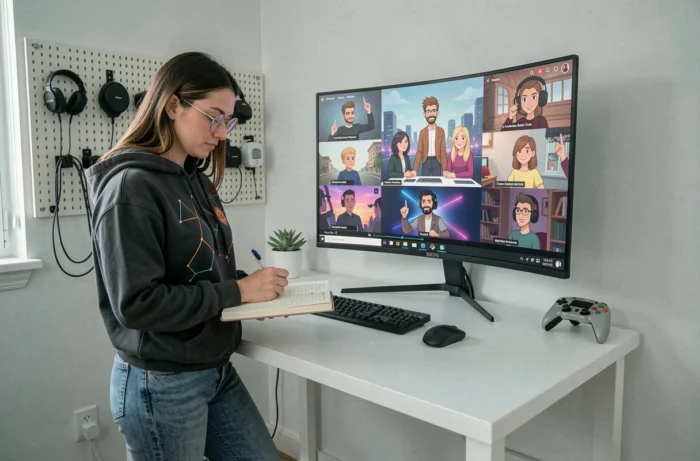
Representation of women in pop culture: beyond token heroines
The problem is not simply the number of female characters. A game or film can feature a female protagonist while still reproducing passive tropes: a story centered on trauma inflicted on her, a character arc dependent on a male mentor, or a body design that has no connection to the fictional setting.
French-language geek literature has begun to map these biases. Project M42, led by the teams behind Bordeaux Geekfest and Angers Geekfest, devotes its second volume to geek culture for women, with six themed features covering children’s literature, comics, film, and video games. The value of this kind of work lies in its cross-disciplinary approach: gender stereotypes move from one medium to another and reinforce one another.
In comics, the evolution of female characters in the Batman universe illustrates this dynamic well. Female characters have gone from playing supporting roles to becoming complex antagonists and then independent protagonists. This shift is neither linear nor complete, and each era leaves its own contradictions imprinted on these characters.
Women creators in the geek industry: access to decision-making roles
Distinguishing between leisure activities and access to careers remains analytically important. A summary of the French video game market indicates that 52% of studios plan to expand their teams. This recruitment drive offers a real opportunity to change the makeup of development teams, provided that hiring and promotion processes are audited.
Technical roles (programming and technical direction) remain the least gender-balanced. Game design, narrative, and community management roles are more evenly distributed, but creative leadership and executive production concentrate decision-making power and remain predominantly male.
We see French-speaking geek festivals playing a role in raising visibility that the industry itself struggles to provide. Through their talks and publications, Bordeaux Geekfest and Angers Geekfest create spaces where women’s paths into geek culture and creation are documented and discussed outside publishers’ promotional filters.
Practical steps toward equal participation
Several technical and organizational measures are available. Implementing them is up to game publishers, streaming platforms, and community organizers.
- Enable automatic voice recording in ranked matches, with temporary storage for handling reports, so moderators can verify the context of voice harassment
- Create a reporting category specifically for gender-based harassment, separate from spam or generic insults, to enable appropriate handling and graduated sanctions
- Publish transparency reports covering the number of reports by type, processing times, and sanction rates, as some social platforms are beginning to do under regulatory pressure
- Make esports partnerships and financial support conditional on measurable commitments to gender balance in competitive teams and organizational staff

Online harassment and reporting bias: what recent data shows
The report Mujeres en VG: Reporte LATAM 2025, based on a survey conducted in January and February 2025 among respondents from twelve Latin American countries, highlights a counterintuitive trend. Personal reports of harassment are declining, while accounts of violence witnessed against other women are increasing.
This gap between direct experience and witnessing suggests a process of normalization. Women gamers who regularly face hostile behavior may eventually stop categorizing it as harassment, while still recognizing it when they see it happening to others. This reporting bias makes quantitative surveys inadequate unless they account for both perspectives.
For women in online geek culture, the implication is clear: a drop in complaints does not mean the environment has improved. Platforms that use the number of reports as an indicator of community health are actually measuring their users’ resignation.
Online communities for women in geek culture: structure and limitations
Spaces dedicated to women in geek culture have multiplied in the form of private Discord servers, themed forums, and specialist media outlets. This parallel structure provides a refuge, but it raises a fundamental issue: it shifts the burden of adapting onto women rather than onto mixed-gender spaces.
Collectives such as Pixielles combine public awareness-raising with competitive representation. This model works for visibility, but less so for transforming mainstream spaces. As long as public servers and game lobbies remain hostile and unmoderated environments, women’s communities will remain enclaves rather than drivers of systemic change.
Women in geek culture are not short on passion or skills. What they lack are moderation systems equipped to address the problem, reliable data on gender-based harassment, and editorial commitment from studios. Festivals, publications such as M42, and online media document what already exists. The next challenge is changing the platforms themselves.