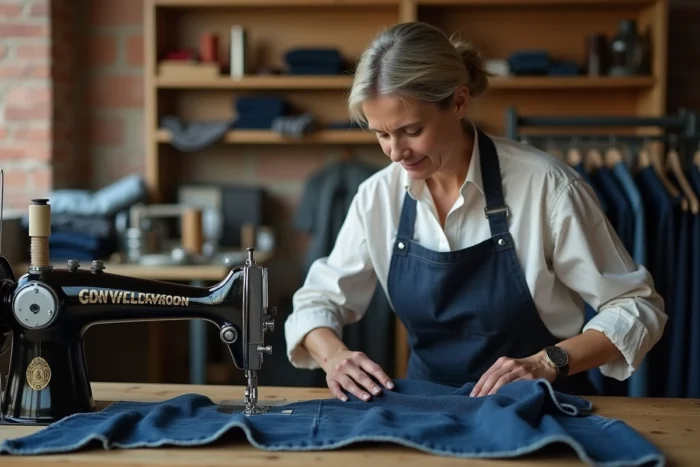
Have you ever tried to sew a hem on jeans with a standard home sewing machine? The needle slows down, the fabric refuses to move forward, and the stitches pile up in place. The problem doesn’t always stem from your technique. Choosing a sewing machine for thick fabrics requires understanding what happens mechanically when the fabric becomes dense, heavy, or multilayered.
Several technical criteria make all the difference between a machine that struggles and one that sews through denim without flinching.
Motor power and stitching speed for thick fabric
The motor power is the first filter. On a standard home machine, the motor typically runs at around 70 to 90 W. For regular use on materials like denim, oilcloth, or faux leather, this is not sufficient.
Recent technical guides recommend aiming for at least 100 W for regular sewing on thick layers. Versatile semi-professional models often exceed 120 W, allowing them to maintain a stable stitching speed even on multiple stacked layers.
Why does speed matter as much as raw power? Because a machine that runs too fast on thick fabric will break the thread or distort the stitch. The ideal speed is between 800 and 1,200 stitches per minute for this type of work, well below industrial speeds but significantly above what entry-level machines offer.
To identify a sewing machine suitable for thick fabrics, check the manufacturer’s technical sheet: the motor power is almost always listed, but the recommended stitching speed by fabric type is less frequently indicated. Prefer brands that detail these specifications.
Fabric feeding: feed dogs and presser foot
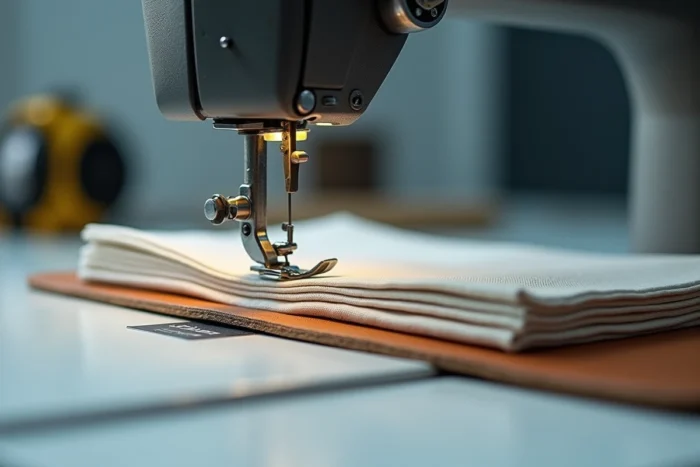
A powerful motor is useless if the fabric doesn’t move properly under the needle. It’s the feeding system that does the actual work: the feed dogs (the small metal teeth under the plate) grip the fabric from below, while the presser foot pushes down from above.
On thin fabric, this duo works effortlessly. On denim folded four times or faux leather, two problems arise. The fabric slips under the foot, misaligning the layers. Or the fabric sticks to the foot, blocking the advancement.
Adjustable presser foot pressure
The presser foot pressure should be manually adjustable. On entry-level machines, this pressure is fixed. With thick fabric, too much pressure crushes the layers and prevents the feed dogs from doing their job. Too little pressure allows the fabric to float.
Some recently released machines incorporate a dynamic thickness sensor that automatically adjusts the foot pressure and the height of the feed dogs according to the fabric’s relief. This technology is particularly useful when transitioning from a thin area (two layers of cotton) to a thick area (four layers of denim at a cross seam) within the same project.
Presser foot lift height
The maximum lift height of the presser foot determines the thickness of fabric you can physically slide under the needle. Look for a foot lift of at least 6 mm, ideally more. Many home machines cap at 4 or 5 mm, which automatically excludes multilayer assemblies.
Needle and thread: the often-overlooked duo
You could have the most powerful machine on the market, but if the needle and thread are not suitable, the result will be poor. This is a point that most guides gloss over, yet it directly affects stitch quality.
- For denim or heavy canvas, a needle size of 90/14 to 110/18 is necessary. A needle that is too fine bends or breaks on dense layers.
- The thread must match the needle: a strong polyester thread (not a basting thread) prevents breakage during sewing. On denim, a special jean thread made of coated cotton provides a cleaner stitch.
- The needle must be changed much more frequently on thick fabric than on thin fabric. A dull needle no longer penetrates dense fabric properly and causes skipped stitches.
Before blaming your machine, check these two elements. Changing the needle resolves a good portion of the problems wrongly attributed to a lack of power.
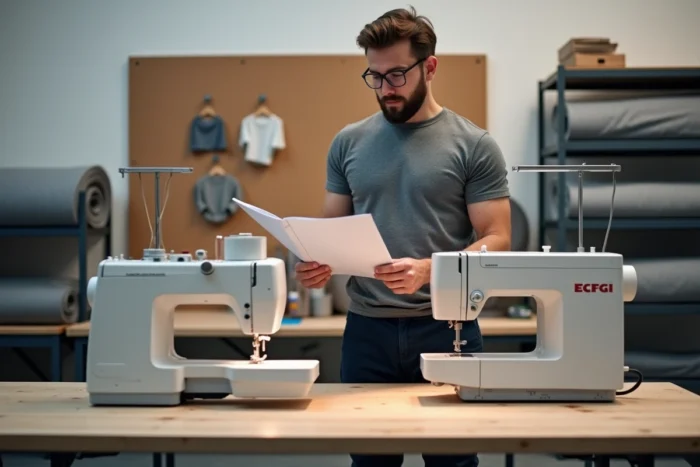
Mechanical or electronic machine for sewing denim
The choice between mechanical and electronic often comes up in discussions. Each technology has distinct characteristics when it comes to thick layers.
A mechanical machine has no electronic board, no screen, and no programmed stitches. Its advantage is that the motor transmits its power directly to the needle without software regulation. On thick fabric, this direct transmission results in consistent penetration force. Robust mechanical machines from brands like Janome, Brother, or Singer in their semi-professional range remain reliable choices for this type of work.
An electronic machine offers more comfort: foot speed adjustment or slider, decorative stitches, automatic threading. However, some entry-level electronic models automatically reduce speed when resistance increases, causing uneven stitches on thick areas.
- If you primarily sew heavy materials (bags, upholstery, denim), a robust mechanical machine with a good motor will be more reliable over time.
- If you alternate between thin and thick projects, a mid-range or high-end electronic machine with adjustable foot pressure offers more versatility.
- In any case, avoid entry-level models with insufficient motor power, regardless of the type of technology.
The determining factor is not the technology itself but the quality of the feeding mechanism and the actual motor power. A low-end mechanical machine will jam just as much as a low-end electronic machine when faced with six layers of canvas.
Before purchasing, test the machine on a sample of the fabric you plan to sew, if possible. A trial on your own material is worth more than all the technical sheets. Specialized sewing retailers generally offer this type of test in-store, which remains the most reliable way to ensure that the machine meets your projects.