Your tomato plants are growing tall without producing any fruit, your salads bolt after just two weeks, and the basil is turning yellow despite daily watering. These situations often share a common cause: a garden set up without considering a few simple fundamentals. Before buying seeds or potting soil, some initial choices condition the entire season.
Living soil in the garden: why not digging changes everything
You may have noticed that the soil in the forest is loose, dark, and easy to dig by hand? No one turns it over. Earthworms, microscopic fungi, and bacteria do the work continuously. A garden can operate on the same principle.
The so-called “no-dig” method involves covering the soil without ever turning it over. You lay down unprinted brown cardboard on the grass or bare soil, then a layer of mature compost, and finally a mulch. Microorganisms decompose the cardboard in a few months, and the soil underneath remains structured, aerated, and full of life.
Practically, this means it is possible to start a garden on a lawn without a tiller, without a spade, and without back pain. The cardboard smothers weeds, and the compost nourishes future plantings. For gardeners who want to find Conseil au Jardin online, this is an accessible starting point that requires little equipment.
Traditional digging breaks the tunnels of earthworms and exposes the deeper layers of soil to air. The result: organic matter degrades faster, nutrients wash away with rain, and the soil compacts again in a few weeks. A permanently covered soil retains water and nutrients better.
Watering the garden: frequency matters less than depth
A small daily watering moistens the top few centimeters of soil, then evaporates. The roots remain near the surface, fragile, dependent on the next watering. This reflex is one of the most common mistakes in gardening.
Watering less often but for longer encourages roots to go deeper in search of moisture. A well-rooted plant is better able to withstand heat, missed waterings, and wind.
When and how to water your vegetables
Water early in the morning, directly at the base of the plants. Water sitting on the foliage in full sun does not burn the leaves (this is a myth), but it promotes the development of pathogenic fungi like downy mildew. In the morning, the soil is still cool: the water penetrates before the heat causes rapid evaporation.
The proximity of a water source is often an underestimated criterion when choosing the location of the garden. If the nearest tap is thirty meters away, the chore of watering quickly becomes discouraging. Placing the garden near a water access makes regularity easier, and it is regularity that makes the difference.
Beginner garden: start small to harvest more
Why want to plant twenty varieties in the first year? A large, poorly maintained garden produces less than a small, well-tended space. Recent sources converge on this point: it is better to grow a few vegetables in a small area than to spread your energy over dozens of square meters.
Starting small allows you to learn to observe. You notice which areas receive the most sun, where water stagnates after rain, and which plants attract aphids. These observations are worth more than any gardening book.
Easy vegetables to grow for a first garden
- Radishes germinate in a few days and can be harvested in less than a month, providing quick visible results and motivation for what comes next
- Zucchini produce abundantly with little care, as long as they are spaced sufficiently to allow air circulation between the leaves
- Herbs (parsley, chives, mint) require little space, can be harvested gradually, and regrow after each cut
- Dwarf beans fix nitrogen in the soil, benefiting subsequent crops, and do not require staking
Three or four well-chosen crops are enough for a first season. The following year, you will add varieties already knowing the specifics of your soil and exposure.
Plant associations and biodiversity in the garden
Planting flowers among the vegetables is not just an aesthetic whim. Marigolds, nasturtiums, and African marigolds attract pollinating insects and beneficials like hoverflies, whose larvae devour aphids. This is free biological pest control.
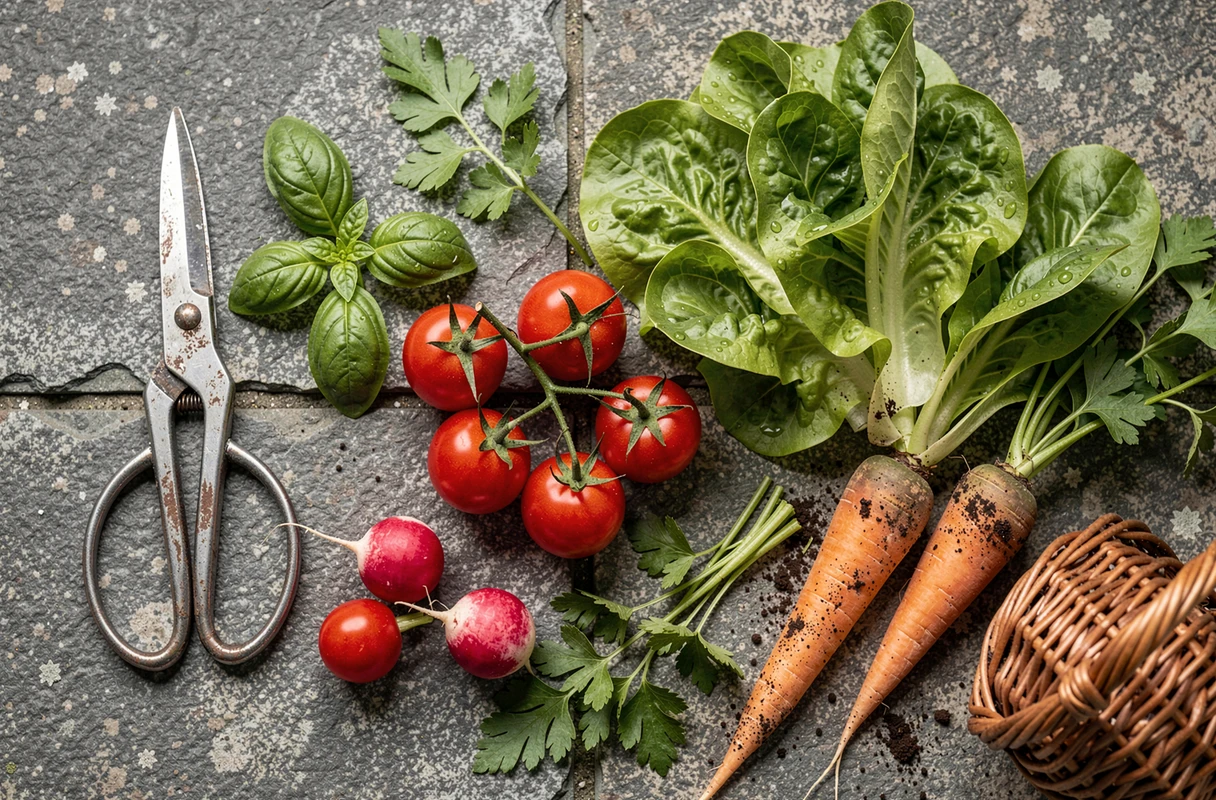
Companion plants also work through repulsion. Basil planted next to tomatoes wards off certain pests. Carrots and leeks protect each other from their respective flies. These associations are not magical, but they reduce pest pressure without any treatment.
Creating refuge areas for beneficials
Leaving a corner of the garden a bit “wild” (tall grasses, wood piles, flat stones) provides shelter for ladybugs, hedgehogs, and toads. An overly tidy garden is one that lacks natural allies. A few square meters left unmowed are enough to host useful wildlife.
- A pile of branches on the ground serves as a winter refuge for predatory insects of aphids and slugs
- A flowering strip along the garden (phacelia, clover, borage) nourishes pollinators from spring to autumn
- A small water point (even a dish) attracts amphibians, effective against slugs
This approach requires less work than systematic weeding. It transforms the garden into an ecosystem rather than a battlefield against pests.
A productive garden does not rely on the size of the plot or the quantity of seeds purchased. The soil, water, and patience are the three true levers. Cover your soil, water deeply, and leave a little room for life. The results of the first season will guide all the following ones.