
A raw denim, a white t-shirt, white sneakers: the outfit seems ordinary. Add a tan leather belt and a well-chosen pair of sunglasses, and the whole look shifts. Fashion accessories do not just decorate an outfit; they construct it. Understanding how to choose and combine them allows for varying looks without multiplying clothing items.
Materials and finishes: what distinguishes a lasting accessory
Before discussing style, let’s talk about what happens between your fingers. The material of an accessory determines its longevity, comfort, and the image it conveys.
A full-grain leather bag, for example, develops a patina over the years. Its surface retains signs of use and gains character. In contrast, a cheap faux leather cracks after a few months and loses its smooth appearance.
The same reasoning applies to jewelry. A fine gold-plated alloy withstands better than simply gold-colored metal, which tarnishes upon contact with sweat. For scarves and shawls, silk or modal provides a fluid drape that polyester cannot replicate.
You can also discover Belle et Élégante online to compare different finishes on common items like belts, bags, or jewelry.
Checking quality takes a few seconds: observe the stitching (regular or not), test the flexibility of the leather, see if the clasps open without force. A well-finished accessory is recognizable by touch as much as by sight.

Belt, bag, jewelry: how three pieces transform an outfit
Instead of listing ten categories, let’s focus on three accessories that truly modify the silhouette and visual balance of a look.
The belt structures the silhouette
Worn over a flowing dress, a belt defines the waist and creates two distinct volumes: the bodice and the skirt. On wide pants, it anchors the gaze at the waist and avoids the “pajama” effect.
Are you torn between a thin and a wide belt? The rule is simple. A thin belt elongates the silhouette, while a wide belt cuts it. Petite body types often benefit from choosing thin models that do not bisect the torso.
The bag sets the tone of the look
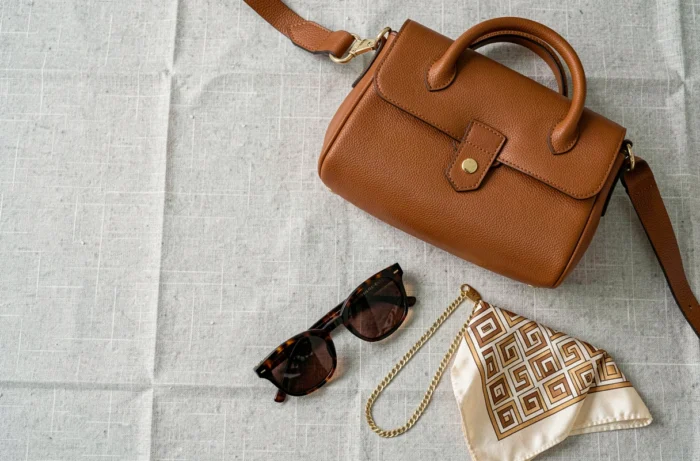
A compact crossbody bag leans the outfit towards casual. A structured bag with rigid handles pulls it towards formal. The choice of bag conditions the overall reading of your style, sometimes more than the clothing itself.
In practice, owning two bags with opposing characteristics (one soft and one rigid, or one small and one large) is enough to cover most situations.
Jewelry adjusts the intensity
A choker on a V-neck draws attention to the face. Dangle earrings visually elongate the neck. Jewelry acts like intensity sliders: discreet, they let the clothing speak; bold, they become the main focus.
It’s better to have one visible piece of jewelry than three accessories competing for attention. Choose a focal point for each outfit.
Combining colors without a false note
Color coherence makes the difference between an assembled look and a “stacked” look. Two approaches work well in everyday life.
- The color echo: your belt matches the shade of your shoes or bag. This visual link unifies the outfit effortlessly. For example, camel sandals with a camel bag over a navy dress.
- The controlled contrast: an accessory in a bold color (red, mustard yellow, pine green) stands out against a neutral outfit (black, white, gray, beige). The accessory then becomes the focal point of the gaze.
- The tone-on-tone: gold jewelry with a scarf in warm hues, or silver jewelry with gray-framed glasses. This approach creates a soft harmony, suitable for professional contexts.
In any case, limit the accessory palette to a maximum of two colors to maintain a clear reading of the outfit.
Claims of “eco-responsibility” on accessories: what changes in September 2026
The European directive 2024/825, known as Empowering Consumers for the Green Transition, comes into effect on September 27, 2026. It prohibits generic terms like “eco-friendly,” “green,” “sustainable,” or “carbon-neutral” on products sold to European consumers unless the brand provides verifiable proof or independent certification in the same medium.
In practical terms, a piece of jewelry labeled “eco-responsible” without a recognized label will be in violation. Bags, belts, glasses, and scarves are all affected.
Why does this information matter for your accessory choices? Because vague sustainability claims guarantee nothing about the actual quality of the product. Starting at the end of September 2026, serious brands will display precise certifications. Others will simply remove their claims.
Before purchasing an accessory marketed as “sustainable,” check three points:
- The presence of an independent label (not just an internal brand logo)
- A description of the certification on the product sheet or label
- The traceability of the main material (origin of the leather, type of metal, source of the textile)

Choosing fashion accessories comes down to mastering three variables: material, shape, and color. A well-constructed leather bag, a belt suited to your body type, and a piece of jewelry placed correctly are enough to elevate any look. With the new European framework on environmental claims, brand transparency also becomes a concrete selection criterion, not just a marketing argument.