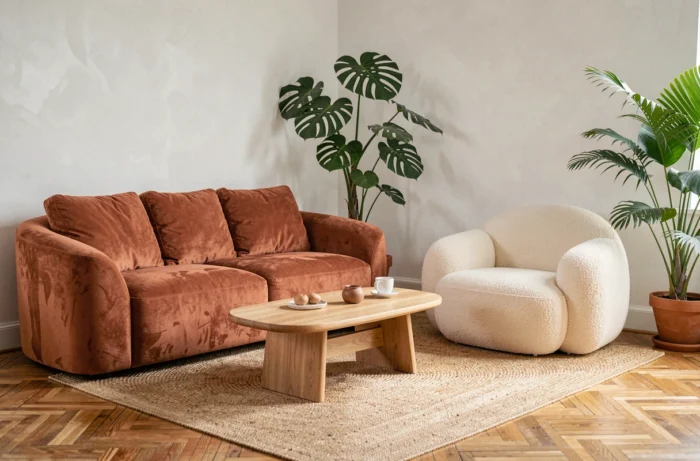
A sofa with rounded shapes, an armchair that looks like a big cushion placed on the floor, a mirror with no right angles: the chubby trend transforms interiors into spaces where every piece of furniture seems to invite you to sit down. This style, which originated in the 1970s and has been updated, focuses on generous curves, soft volumes, and enveloping textures.
Adopting chubby decor in your interior is not just about choosing round objects. The choice of materials, the internal structure of the furniture, and their maintenance are just as important as their silhouette.
Foam, structure, and fabric: what makes a chubby piece of furniture durable or fragile
Have you ever noticed that some rounded armchairs lose their shape after a few months? The problem rarely comes from the design. It stems from what you can’t see: the foam and the frame.
A piece of furniture with curved lines requires more complex manufacturing than an angular piece. Straight structures rely on simple wooden or metal frames that are easy to assemble. Bulging shapes require curved frames or specific molds. A poorly designed frame under thick foam will deform in a few months. The result: a sofa that sags on one side or a pouf that never regains its original roundness.
The density of the foam plays a direct role. Foam that is too soft gives an appealing plush look in the store, but it compresses quickly under body weight. For daily use, a sufficiently dense weight is needed so that the seat retains its shape for several years. Some high-end brands layer two types: a firm foam for structural support, then a soft layer on the surface for tactile comfort.
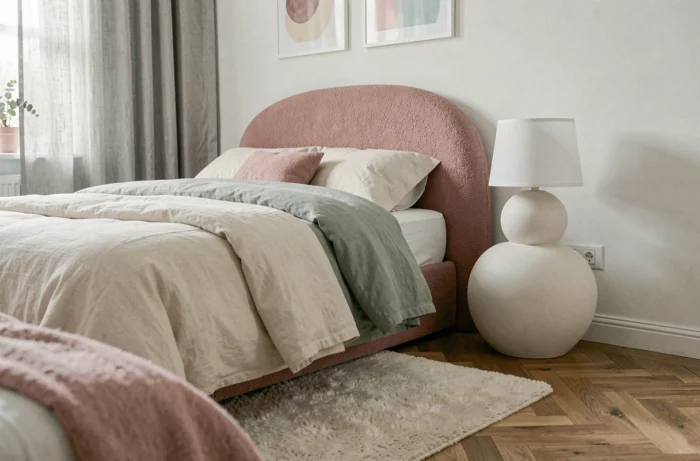
In terms of upholstery, boucle fabrics dominate the chubby aesthetic. IKEA recently launched a pill-shaped sofa covered in boucle fabric containing at least 90% recycled polyester. This type of material illustrates the convergence between round shapes and sustainable material choices. Boucle catches the light on the curves, visually enhances the volume, but it also traps dust and pet hair. Plan for regular maintenance with a brush or a vacuum with a soft nozzle.
If you want to explore the chubby trend on Tendances Déco, you will find that the most refined pieces always combine a solid internal structure and a covering designed to last.
Chubby decoration beyond furniture: walls, moldings, and rounded niches
The trend is no longer limited to sofas and armchairs. It is now extending to walls, door frames, and niches. We talk about “soft architecture”: the surfaces themselves become tactile and softened.
In practical terms, this translates to moldings with bulging profiles rather than straight lines, wall niches with rounded edges carved into plaster, or soft arches as a separation between two rooms. The goal is to eliminate sharp angles to create an enveloping atmosphere, even without changing a single piece of furniture.
- Rounded niches in a plaster wall hold decorative objects and replace traditional shelves, while enhancing the sculptural effect of the room.
- Bulging profile moldings add relief without the rigidity of traditional cornices. They work well in both modern interiors and classic decor.
- Arc-shaped partitions between the living room and dining room soften the transition between spaces and enhance the feeling of fluidity.
This approach has a practical advantage: modifying soft architecture often costs less than replacing a designer sofa. A drywall artisan can create a rounded niche in just a few days. The result transforms an entire room without touching the existing furniture.
Colors and textures for a cohesive chubby interior
Round shapes call for colors that enhance their softness. Muted shades work better than bright and saturated colors. Warm beiges, powdery terracottas, faded pinks, and off-whites highlight the volumes without creating harsh contrasts.
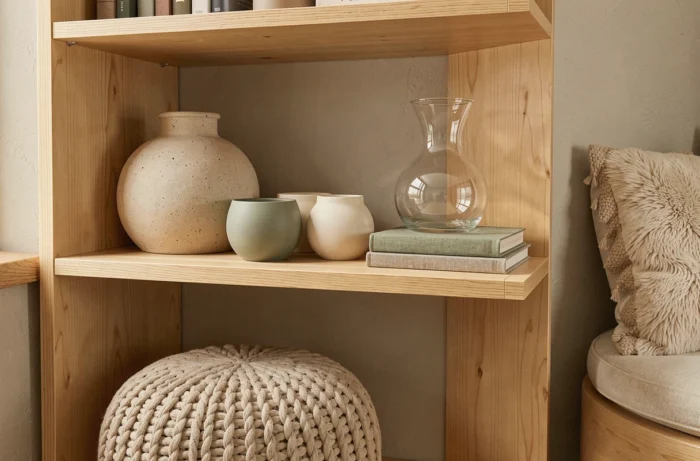
Why this choice? A bright color on a rounded shape draws the eye massively. The piece of furniture becomes a visual spot rather than an integrated element in the room. Neutral tones allow the shape to speak for itself.
For textures, the rule is simple: multiply tactile materials. Corduroy, crumpled linen, boucle wool, and brushed cotton combine naturally. The idea is that each surface invites touch. A velvet cushion placed on a boucle sofa, with a thick wool throw on the armrest, creates three different sensations in a small space.
- Corduroy on a chubby pouf accentuates the plump effect and captures light differently depending on the angle.
- Washed linen on curtains or cushion covers provides a matte counterpoint that avoids excess shine.
- Boucle wool, in rugs or throws, visually anchors rounded furniture to the floor and warms up the whole.
Pieces to prioritize and mistakes to avoid with the chubby style
The living room remains the most natural space for chubby design. It is the area where people sit and relax. A generously shaped sofa finds its place here effortlessly. The bedroom follows, with upholstered headboards with rounded edges and nightstands with bulging silhouettes.
The bathroom is a riskier area. Rounded sinks and mirrors without angles work visually, but constant humidity weakens foams and boucle fabrics. Reserve textile materials for dry rooms.
The most common mistake is filling an entire room with curved shapes. Without any straight lines to structure the gaze, the space loses its readability. A straight wooden plank floor, a linear bookshelf, or a geometric light fixture is enough to create balance. Chubby works by contrast with its environment, not by saturation.
Lastly, a point often overlooked: the safety of low rounded furniture, such as poufs and coffee tables without visible legs. A piece of furniture without sharp edges is reassuring for children, but its stability depends on internal weighting. Ensure that the bottom is heavy enough or non-slip to prevent it from sliding on a waxed floor.