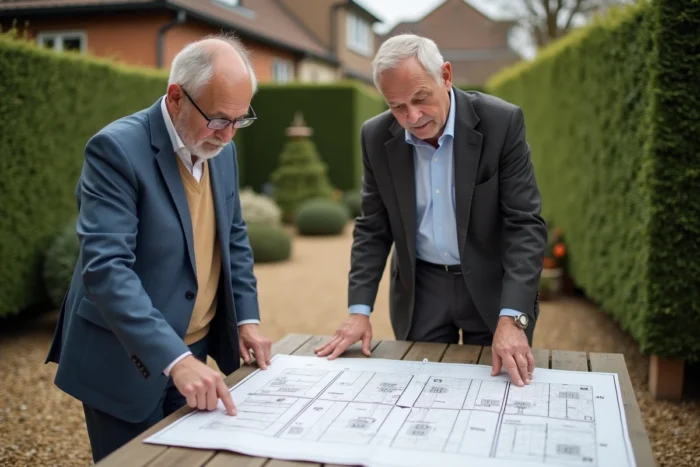
Dividing a jointly owned property requires reconciling two distinct logics: that of urban planning law, which regulates any parcel division, and that of civil law, which requires the agreement of co-owners. The overlap of these two legal frameworks creates bottlenecks that classic guides rarely address together. This article outlines the real constraints, often underestimated timelines, and available levers to successfully complete this type of project.
Appeal deadlines after division authorization: the unknown trap
Obtaining a preliminary declaration or a development permit is not enough to legally secure the division of a jointly owned property. Two deadlines run from the issuance of the authorization, and they are frequently overlooked in family projects.
The first is the third-party appeal period, set at two months from the posting of the authorization on the property. The second, less known, is the administrative withdrawal period by the prefect, which can last up to three months. As long as these deadlines are not exhausted, any signing of a notarial deed of partition or sale remains risky.
In practice, this means that several months pass between the submission of the file at the town hall and the actual possibility of finalizing the division with the notary. A co-owner eager to sell their share or start a construction project must incorporate this timeline from the outset, or risk having to postpone the transaction. A notary who is well-versed in the procedures for dividing their land in joint ownership will always recommend waiting for the complete expiration of these deadlines before drafting the final deed.

Two-thirds rule and blockage among co-owners
The civil code stipulates that acts of ordinary management of a jointly owned property can be decided by a two-thirds majority of the joint rights. However, parcel division does not fall under simple management. It alters the very substance of the property, bringing it closer to a disposition act.
The consequence is direct: dividing a jointly owned property generally requires the unanimity of the co-owners. If one of the co-owners refuses, the project becomes blocked. The only way to circumvent this is through judicial means, by filing a request for partition with the court.
Amicable partition or judicial partition
An amicable partition remains the quickest and least expensive solution. It requires all co-owners to agree on the principle of division, the layout of the new parcels, and the distribution of lots. The surveyor intervenes to demarcate the land, and the notary formalizes the operation.
When agreement is impossible, judicial partition comes into play. The court can order the division, appoint a notary, and, if necessary, proceed with a sale by auction of the property. The timelines of a judicial procedure often far exceed those of an amicable partition, and legal fees are added to the costs of the surveyor and notary.
- An amicable partition requires unanimous agreement among co-owners on the principle and terms of the division
- A judicial partition can be requested by any co-owner at any time, as no one can be forced to remain in joint ownership
- A sale by auction is required when the land cannot be divided into lots of equivalent value without depreciation
- The preemption right of co-owners applies if a lot is sold to a third party after the division
Digital submission of urban planning authorizations for parcel division
Since 2022, municipalities with more than 3,500 inhabitants must provide an electronic means for submitting urban planning authorizations. This obligation directly concerns preliminary declarations and development permits related to land division.
In practice, the digital platform changes the management of the division file in joint ownership. The acknowledgment of receipt is electronic, tracking is done online, and exchanges with the instructor are digitized. For a project carried by several co-owners who do not reside in the same city, this evolution simplifies coordination.
Field feedback varies on this point: some town halls, particularly in rural municipalities below the threshold, continue to require paper submissions in multiple copies. Checking the submission method accepted by the relevant town hall before preparing the file avoids wasting time.
Content of the preliminary declaration file
The parcel division file must include several documents, whether the submission is paper or digital:
- The Cerfa form for preliminary declaration for land division
- A location plan of the land within the municipality
- A division plan prepared by a surveyor, showing the boundaries of the future parcels
- A descriptive notice specifying the area of each lot and the planned access
The intervention of the surveyor is mandatory to establish the surveying document, which will then be used for updating the land registry. Without this document, the land publicity service will refuse to register the division.

Preemption right and sale of share after land division
Once the land is divided, each co-owner may be assigned a distinct lot during the notarial partition. If a co-owner wishes to sell their lot to a third party rather than to another co-owner, the preemption right comes into play.
The notification of the intention to sell must be made by a bailiff. The deed specifies the price, the conditions of the sale, and the identity of the prospective buyer. The other co-owners then have one month to exercise their preemption right. After this period without a response, the sale to the third party can be concluded.
The real estate security contribution and the sharing right apply to the transaction. The sharing right represents a significant tax burden that co-owners must anticipate in their profitability calculations, especially if the land has increased in value since the initial acquisition.
Dividing a jointly owned property remains an operation that intertwines urban planning, geometry, and civil law within a constrained timeline. The main pitfall is neither technical nor administrative: it is the lack of agreement among co-owners on the very principle of division. Clarifying each party’s intentions before commissioning a surveyor helps avoid incurred costs for a project that will not come to fruition.