You add chlorine to your pool, yet it seems to disappear in just a few hours. The sun shines, the level drops, and you start again the next day. This scenario has a well-identified culprit: CYA, or cyanuric acid. This stabilizer protects chlorine from ultraviolet rays, but its dosage requires precision. Too little, and chlorine evaporates. Too much, and it becomes ineffective. Understanding CYA in a pool means understanding why your treatment works, or doesn’t.
CYA/free chlorine ratio: the data that manuals don’t mention
Most pool owners think in terms of a fixed free chlorine value, often between 1 and 3 ppm. This approach poses a significant problem: it completely ignores the level of CYA present in the pool.
Industry practitioners now use a more reliable calculation. Free chlorine should represent about 7.5% of the CYA level. For a shock treatment, we aim for about 40% of the CYA. In practical terms, a pool showing 100 ppm of CYA with only 3 ppm of free chlorine is nearly without effective disinfection, even if the test strips seem correct.
This explains the recurring cases of green pools despite chlorine being “within the norm.” Chlorine is indeed present, but excess CYA neutralizes it. To delve deeper into this mechanism, a detailed file discusses CYA in a pool on Be At Home with practical guidelines.
Before adding chlorine, ask yourself: what is my current CYA level? The answer determines everything else.
Ideal CYA level: the range to respect according to your setup
The recommended stabilizer level is between 30 and 50 ppm for an outdoor pool treated with chlorine. This range offers a good compromise between sun protection and the disinfecting power of chlorine.
Do you have a salt electrolyzer? The situation changes. Electrolyzer manufacturers often recommend a CYA between 60 and 80 ppm, as chlorine production is continuous and the stabilizer helps maintain a consistent level against UV rays. Exceeding this range is still not advisable, even with an electrolyzer.
Indoor pool: a special case
If your pool is permanently covered, there is no reason for CYA to be present. Without exposure to UV rays, chlorine does not degrade under sunlight. Recent technical guides recommend a target of 0 ppm of CYA in indoor pools, with at most a tolerance related to the filling water. Adding stabilizer in this context slows down disinfection without providing any benefit.
Measuring and correcting the CYA in your pool: a practical method
Standard test strips provide an approximate indication of the stabilizer level. For a more reliable reading, the turbidity test (a graduated tube in which you pour water until you can no longer see a black dot at the bottom) remains the accessible reference for individuals.
You have measured your level. Two situations arise.
CYA too low: how to raise the stabilizer
A level below 30 ppm outdoors means that chlorine degrades very quickly in the sun. Two options allow for correction:
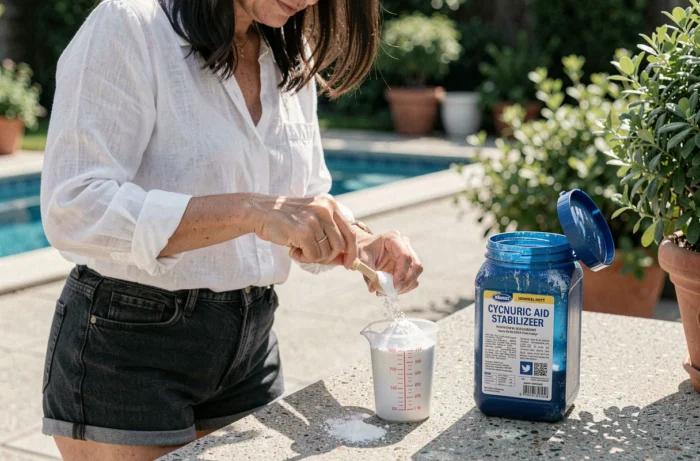
- Add pure cyanuric acid (granules) directly into the skimmer or in a bucket of warm water, respecting the dosage relative to the pool volume. The effect is not immediate: it often takes several days for the product to fully dissolve and for the measurement to stabilize.
- Switch to stabilized chlorine tablets (dichloroisocyanurate or trichlor). These products already contain CYA and release it with each dissolution. Caution: this is also the main cause of gradual overdosing, as CYA accumulates in the water and does not evaporate.
CYA too high: the trap of over-stabilizing
Beyond 80 to 100 ppm, chlorine loses a significant part of its effectiveness. The water can become cloudy or green despite regular treatment. No matter how much chlorine you add, the excess stabilizer “blocks” its disinfecting action.
There is no chemical product capable of lowering CYA. The only solution to reduce excess stabilizer is partial draining. You replace part of the pool water with fresh (unstabilized) water, then measure again after complete mixing.
Common errors in pool stabilizer dosing
Some maintenance habits unknowingly cause a gradual increase in CYA.
- Exclusively using stabilized chlorine tablets throughout the season. Each dissolved tablet adds CYA to the water. After several weeks, the level rises without anyone noticing if measurements are not taken regularly.
- Never renewing the pool water. Without fresh water input (rain, partial draining, backwashing the filter), CYA only accumulates season after season.
- Performing a shock treatment with stabilized chlorine. A shock should be done with unstabilized chlorine (calcium or sodium hypochlorite), otherwise, you add a massive dose of CYA at the same time as chlorine.
Have you noticed that your chlorine consumption increases every summer without explanation? Measure the CYA before doubling the doses. The problem probably lies there.
Regular monitoring of the stabilizer level, at least once a month during the season, helps avoid the snowball effect. Alternating stabilized chlorine and unstabilized chlorine throughout the season remains the simplest method to keep CYA under control without frequently renewing the pool water.