When looking for a feminine name that is both gentle and assertive, Ambre consistently appears on the lists. This is no coincidence: the name climbed to the 3rd national rank for female names in 2024, with 2,815 births that year. Behind this popularity lies a dual etymology, a specific geographical distribution, and parental choices that meet very concrete criteria.
Geographical distribution of the name Ambre in France
Most name profiles only provide a national ranking. This overlooks a useful piece of information: Ambre is not evenly distributed across the territory. Île-de-France has the highest number of births since 1900, with 10,275 babies named Ambre. Auvergne-Rhône-Alpes follows with 7,465 births, and then Hauts-de-France with 6,575.
At the departmental level, it is Nord (59) that dominates with 2,875 births bearing this name since 1900. This concentration in the northern half of the country and in the Paris region gives concrete insight to parents wondering if Ambre will be “too common” in their local school or, on the contrary, unique in their area.
To delve deeper into the origin and meaning of the name Ambre, these territorial data allow for situating the name in a local context, not just in an abstract ranking.

Etymology of the name Ambre: two roots, two stories
Ambre has a dual origin that gives it a rare depth among short names. The first root comes from the Greek “ambrosios,” meaning “immortal.” It is the same word that gave rise to “ambrosia,” the nectar of the gods of Olympus in Greek mythology. The masculine name Ambroise derives directly from this.
The second root is Arabic. The term “anbar” refers to ambergris, a secretion produced by the intestines of the sperm whale, used in perfumery as a fragrance fixative. This rare and precious substance has long circulated on trade routes between the Arab world and medieval Europe.
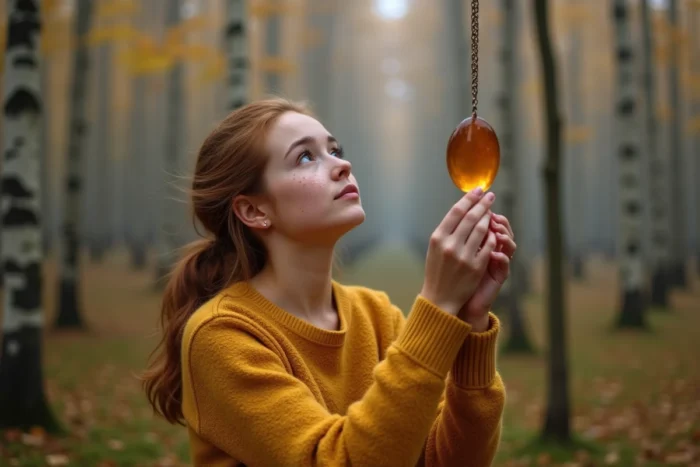
Ambre also refers to fossil tree resin, this golden and translucent stone used in jewelry. It is this third association, visual and tactile, that likely explains the name’s appeal to parents sensitive to nature-related names.
Three associations for one name
- Greek immortality (ambrosios), linking Ambre to mythology and the name Ambroise
- Arabic ambergris (anbar), a rare perfumery material, anchoring the name in the history of trade
- Fossil tree resin, a golden stone valued in jewelry, connecting Ambre to names inspired by minerals and nature
Popularity curve of the name Ambre since the 2000s
Ambre is not an old name that is coming back into fashion. Its rise is recent and has been ongoing for over twenty years. The peak was reached in 2022 with 3,380 births, a record. In 2024, the name remained at the 3rd national rank for female names with 2,815 births, which does not indicate a decline but a slight plateau after a rapid rise.
During the period from 2019 to 2024, there were about 2,965 births per year on average. This volume places Ambre in the category of very popular names without being saturated, unlike some names that explode and then disappear within a few years.
A very marked “youth” name
In 2020, there were 55,855 French women named Ambre, with an average age of 12 years. This figure reveals a very concentrated demographic profile: the vast majority of Ambres are children or teenagers. Parents choosing this name today should know that their daughter will grow up surrounded by many namesakes of the same generation.
Opinions vary on this point: some families consider that the frequency of the name in playgrounds poses a practical problem, while others believe it matters little compared to the sound and meaning of the name.
Feast, variants, and names close to Ambre
The feast of Ambre is celebrated on December 7, the day of Saint Ambrose. This connection to the saints’ calendar comes through the masculine name from which Ambre derives. In practice, few parents know this date, but it appears on all official calendars.
As for variants, we find:
- Amber, the English form, used both in Great Britain and North America
- Ambra, the Italian version, rarer in France
- Ambroise, the original masculine name, still given but in significantly lower proportions
- Ambre is also borne by a few boys in France (26 recorded bearers), making it technically a unisex name, although usage remains predominantly feminine
For parents who are torn between Ambre and a similar name, the difference lies in the final sound and cultural anchoring. Amber sounds more international, Ambra more Mediterranean, while Ambre remains rooted in Francophone tradition.
The name Ambre combines a rich etymology, solidly established popularity, and a geographical distribution that varies by region. These concrete elements allow parents to make an informed choice, beyond the simple character profiles often associated with names. Ambre remains in 2024 one of the most commonly given female names in France, borne by an entire generation that has yet to reach adulthood.