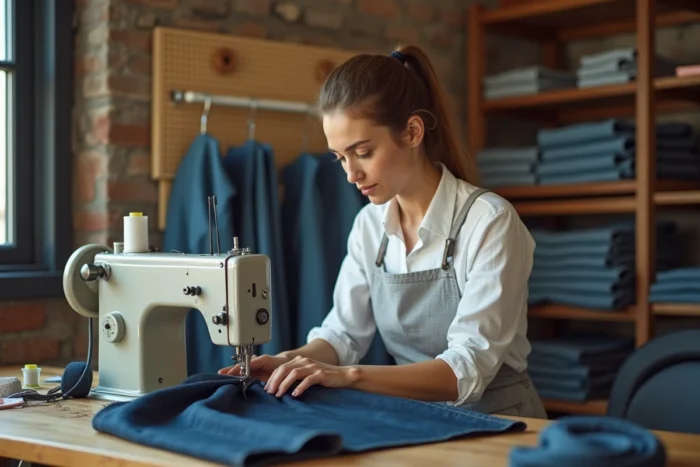
A standard sewing machine operates with a drive and presser foot pressure calibrated for lightweight fabrics. As soon as the material exceeds a certain density (heavy denim, upholstery canvas, leather, faux leather), the feed dogs slip, the needle struggles to pierce, and the stitches become irregular. Choosing a sewing machine suitable for thick fabrics involves identifying three specific mechanical parameters: the type of drive, the piercing power, and the height of the presser foot lift.
Feed Dogs and Fabric Advancement: The Fundamental Technical Criterion
On a classic machine, the feed dogs describe an elliptical motion. The fabric is pushed forward by an arc, which is sufficient for cotton or fine jersey. On thick and rigid fabric, this movement causes a slight tilting of the material at each stitch, resulting in misalignments between layers and uneven stitch lengths.
In recent years, some manufacturers have offered a rectangular motion feed on consumer models, directly inherited from industrial machines. The feed dogs lift, advance horizontally, lower, and then retract, tracing a rectangle rather than an ellipse. The fabric remains pressed against the needle plate for a longer time and advances uniformly, even over multiple layers of denim or webbing.
The Cosia C-180 machine, for example, incorporates this rectangular feed system in a domestic format. This type of mechanism was previously reserved for industrial machines. Its arrival on the consumer market changes the game for seamstresses and tailors who regularly work with thick canvas or faux leather without wanting to invest in professional equipment.
To objectively compare two machines, it is essential to check the type of movement of the feed dogs in the technical specifications. A rectangular or “box feed” drive is a concrete advantage, not a marketing argument. Finding a sewing machine for thick fabrics equipped with this system reduces manual adjustments and rework on thick seams.
Presser Foot Pressure and Lift Height: Two Values to Check Before Purchase
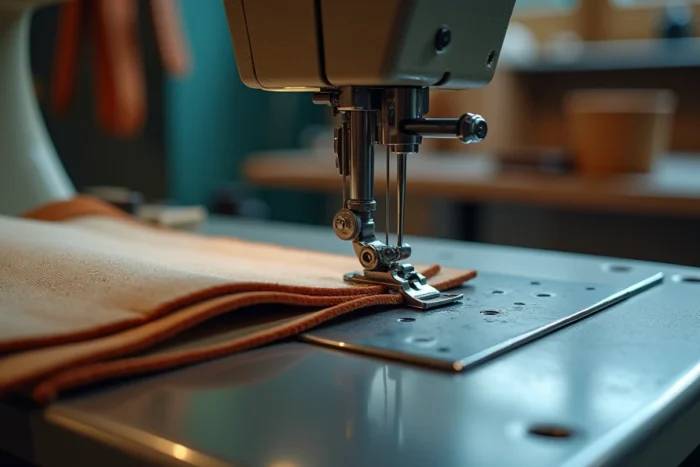
The presser foot pressure determines the force exerted on the fabric during sewing. On a fine fabric, too much pressure crushes the material and creates marks. On a thick fabric, insufficient pressure allows the fabric to float and the layers to shift.
Machines suitable for heavy thicknesses offer an adjustable presser foot pressure, often via a dial or a notched system located on the top of the machine head. This adjustment allows for switching from upholstery velvet to oilcloth without changing machines. Entry-level models that do not offer any pressure adjustment should be avoided for this type of use.
The height of the presser foot lift is another parameter to consider. It determines the maximum thickness of material that the machine can physically accept. For upholstery sewing or lined leather, a lift of at least 6 mm is required, ideally more. Some machines offer a double lift (a first notch and a second notch on the lever) to accommodate the bulkiest layers.
Needle and Thread for Thick Fabric: The Duo That Determines Stitch Strength
Choosing the right machine is not enough if the needle and thread are not suitable for the material. The needle must match the fabric, not the machine.
- For heavy denim and thick canvas, a size 100 or 110 needle with a slightly rounded tip pierces without tearing the tightly woven fibers.
- For leather and faux leather, a triangular-point needle (known as “leather”) cuts through the material instead of piercing it, preventing irregular holes and cracks around the stitch.
- For thick but woven upholstery fabrics (jacquard, structured velvet), a universal needle in size 90 to 100 is suitable in most cases, provided the machine has enough piercing power.
On the thread side, recent specialized guides recommend using good quality polyester thread rather than cotton thread for heavy fabrics. Polyester offers better abrasion resistance and slight elasticity that absorbs tension on stressed seams (seats, bags, straps). Cotton thread breaks more easily under repeated mechanical stress.
Tension Settings and Stitch Length on Thick Fabric
On a fine fabric, the tension of the upper thread and the bobbin thread balances easily. On thick fabric, the thickness of the material alters the thread path within the fabric, and the default tension almost always produces loops on the reverse side or an overly tight upper thread on the right side.
Recommended Stitch Length
A stitch that is too short on thick fabric perforates the material too frequently and weakens the sewing area, especially on leather. A stitch length between 3 and 4 mm is generally suitable for dense materials. Below 2.5 mm, the risk of excessive perforation increases, and the fabric may tear along the stitching line.
Thread Tension
There is no universal value. The reliable method is to test on a scrap of the actual fabric from the project, checking that the knot between the upper thread and the bobbin thread is located in the middle of the fabric thickness. If the bobbin thread comes up on the right side, the upper tension is too strong. If the upper thread is visible on the reverse side, it is too weak.
- Start with the median tension indicated by the manufacturer, then adjust by half a notch on the fabric scrap.
- Change the bobbin between two very different materials (switching from cotton to leather with the same bobbin skews the settings).
- Ensure that the thread unwinds freely from the spool: a stuck or misaligned thread mimics a mechanical tension issue.
The choice of a machine for thick fabrics hinges on verifiable mechanical criteria before purchase: type of feed dog drive, presser foot pressure adjustment, lift height, piercing power. The needle, thread, and tension settings complete the equation, but no adjustment compensates for an undersized machine for the material being worked.