Oxalis includes about 500 species, some of which quickly colonize lawns, flower beds, and vegetable gardens thanks to underground organs (bulbils, rhizomes) or capsules that project their seeds over a distance. Choosing an appropriate selective herbicide requires understanding the propagation method of the targeted species, the type of surface to be treated, and the application schedule.
Underground propagation of oxalis: what influences the choice of product
Before selecting a herbicide, the first reflex is to identify the regrowth mechanism. Creeping oxalis (Oxalis corniculata), the most common in French gardens, develops a creeping habit with stems that root at each node. Pulling it out is almost never enough: even the smallest fragment of a taproot left in the ground can regenerate the plant.
Other species, such as wood sorrel (Oxalis acetosella), propagate through rhizomes in shaded environments. In both cases, regrowth from underground organs makes pulling alone insufficient. A selective chemical treatment acts through the foliage and migrates to these underground reserves, which explains why it yields better results than simple repeated mechanical weeding.
To properly guide the choice of a selective herbicide against oxalis, it is essential to first observe whether the plant propagates through creeping stolons, bulbils, or seed projection, as each method requires a different strategy.
Selective herbicide for lawns and fluroxypyr: what to expect
Selective herbicides sold in garden centers target broadleaf dicotyledons present in lawns. Oxalis falls into this category. Among the common active ingredients, fluroxypyr is frequently mentioned for its effectiveness on this type of weed.
What “selective” really means
A selective lawn herbicide spares grasses (ryegrass, fescue, bluegrass) while destroying broadleaf plants. This selectivity has a direct limit: the product also destroys the dicotyledons you wish to keep. In other words, it is not suitable for treating a perennial bed, a vegetable garden, or a flowering border where broadleaf ornamental plants coexist.
The area of use is therefore crucial. On a lawn, a selective herbicide based on fluroxypyr can yield good results. In a flower bed or at the base of shrubs, other approaches must be used (methodical pulling, thick mulching, tarping).
The timing is more important than the product’s strength
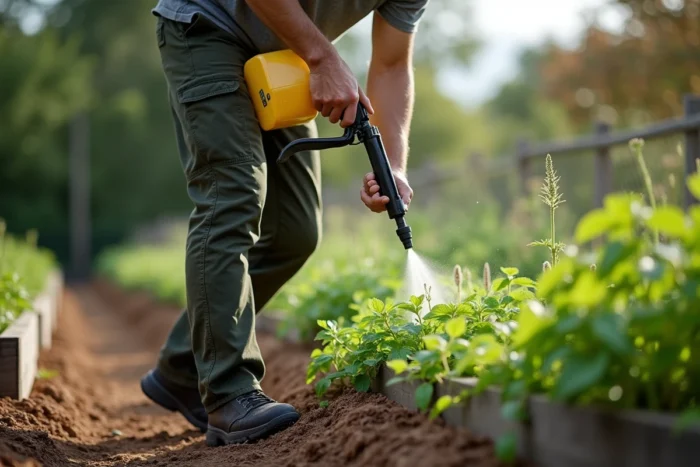
Field reports converge on one point: effectiveness depends more on the growth stage than on the dosage. A treatment applied to young plants, in full active growth (spring, early autumn), penetrates the foliage better and migrates more effectively to the roots.
Treating in the height of summer during intense heat or just before rain significantly reduces foliar absorption. A uniform spray, in calm and dry weather, on well-developed but still tender foliage remains the most favorable configuration.
Concrete criteria for choosing the right selective herbicide against oxalis
The market offers several formulations. Here are the parameters to check before purchasing:
- The active ingredient and its spectrum: check that the label explicitly mentions creeping dicotyledons or oxalis among the targeted weeds. Not all selective lawn herbicides cover the same species.
- The application form: liquid formulations to dilute allow for a more homogeneous spray than granules, which promotes foliar contact on a plant as low as creeping oxalis.
- The recommended number of applications: a single treatment rarely eliminates oxalis. Surviving bulbils and root fragments will regrow. Plan for at least two applications spaced a few weeks apart.
- Compatibility with your lawn: some young or freshly sown grasses do not tolerate selective herbicides well. Adhering to the post-sowing interval indicated on the packaging prevents weakening the lawn.
Oxalis outside the lawn: alternatives when selective is not suitable
In a flower bed, vegetable garden, or planter, using a selective lawn herbicide is excluded. Oxalis coexists with other dicotyledons that we want to preserve. Several complementary methods exist.
Thick mulching (straw, wood chips, dead leaves) reduces the germination of seeds projected by the capsules. For species with creeping stolons, mulching alone is not enough: the stems either grow over it or root in the organic layer.
Repeated manual pulling, done before the formation of seed capsules, limits dissemination. Removing the entire clump with the taproots decreases regrowth, but one must be prepared to repeat the operation several times during the season.
Opaque tarping (woven fabric or black tarp) for several months remains the most radical method outside of lawns. It deprives the plant of light and exhausts its underground reserves. This technique is suitable for an area that can be temporarily left unproductive.
Common mistakes that reduce treatment effectiveness
Several common practices diminish the chances of overcoming oxalis:
- Mowing just before treatment: the reduced leaf surface absorbs less product. Wait a few days after mowing for the foliage to regrow.
- Treating in windy or humid weather: the product drifts to non-target areas or runs off before absorption.
- Only making a single pass and considering the problem solved: regrowth from underground organs is almost systematic. Two to three spaced treatments are generally necessary.
- Using a total herbicide (glyphosate or equivalent) on the lawn thinking it targets oxalis: the grass will be destroyed just like the weed.
The choice of a selective herbicide against oxalis relies less on the brand of the product than on three concrete factors: the correct identification of the present species, adherence to the application schedule on young plants, and the repetition of treatments to exhaust the underground reserves. In areas where a selective lawn herbicide cannot be used, prolonged tarping remains the most reliable option to deprive the plant of all resources.