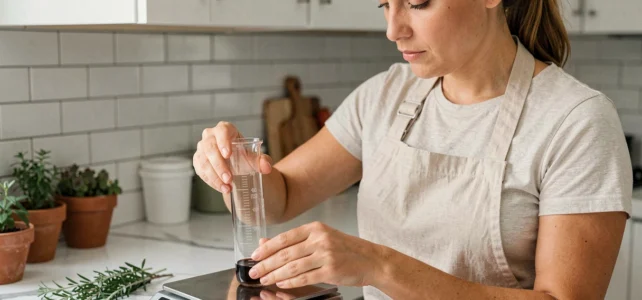
You are following a light recipe, you grab your measuring cup, and the instructions say “15 cl of milk.” Your scale, however, displays grams. This discrepancy between volume and weight comes up with every preparation. Converting centiliters to grams requires just one concept: the density of the measured ingredient.
Why density changes everything in the conversion from cl to grams
Most conversion tables start from a practical shortcut: 1 cl of water corresponds to 10 g. Water has a density of 1, which makes the calculation immediate. Multiply the number of centiliters by 10 and you get the weight in grams.
The problem arises as soon as you move away from water. Olive oil, for example, has a density close to 0.92. Pour 10 cl into a container: you don’t get 100 g, but about 92 g. For honey, it’s the opposite; its density exceeds 1.4, so 10 cl weigh significantly more than 100 g.
In a healthy cooking approach, this difference matters. If you replace cream with oil in a light cake and ignore the density difference, you add less fat than expected, or more, depending on the direction of the error. The result changes in texture and calories per serving.
The formula to remember is simple: weight in grams = volume in cl x density x 10. Looking for the equivalence of 1 cl in grams for each common ingredient helps avoid approximations that can throw off a recipe.
Flour, sugar, oil: the density gaps that trap light recipes
Dry ingredients pose an additional problem. Flour, depending on whether it is packed or aerated in the measuring cup, does not occupy the same weight for an identical volume. Several specialized sources point out that this discrepancy can reach several tens of grams on a measurement of 50 cl. In a light pastry where every gram of carbohydrates is counted, this ambiguity makes the centiliters-grams conversion particularly risky.
Here are the approximate densities of the most common ingredients in light cooking:
- Water, skim milk, broth: density close to 1, so 1 cl ≈ 10 g. The direct conversion works well.
- Oil (olive, canola, coconut): density around 0.92. For 10 cl, count about 92 g. Lighter than water at equal volume.
- Wheat flour: density varies between 0.55 and 0.65 depending on packing. 10 cl of flour weigh much less than 100 g.
- Granulated sugar: density close to 0.85. 10 cl of sugar yield about 85 g, not 100.
- Honey: density greater than 1.4. 10 cl of honey weigh significantly more than 100 g, which increases the calorie intake if you measure by volume.
Confusing cl and grams for a fat or sweetener alters the actual calorie intake of the dish. This is the main trap when cooking light with a measuring cup as the only measuring tool.
Converting without a scale: tablespoons, teaspoons, and measuring cups
Not everyone has a kitchen scale. Good news: a few practical benchmarks are enough to get close to the right amount.
A tablespoon holds about 1.5 cl, which is roughly 15 g of water or milk. For oil, it will be about 14 g. A teaspoon represents about 0.5 cl, or 5 g of water.
The measuring cup remains the most reliable tool for measuring a volume. Read the measurement at eye level, with the liquid resting on a flat surface. The classic error is reading the meniscus from above: a downward gaze skews the reading by a few milliliters, enough to distort a conversion to grams.
The calibrated container method
Do you have cups, bowls, yogurt pots? Weigh them once empty, fill them with water, then weigh again. Note the correspondence. A standard yogurt pot, for example, contains a fixed volume that you can reuse as a benchmark for all your recipes.
This homemade calibration takes two minutes and eliminates repeated approximations for each recipe.

Applying the conversion to a light recipe: a concrete example
Let’s take a light vinaigrette. The recipe calls for 5 cl of olive oil and 3 cl of balsamic vinegar.
For the oil: 5 x 0.92 x 10 = 46 g. For the vinegar (density slightly higher than water, around 1.01): 3 x 10 ≈ 30 g. If you had converted both ingredients as if they were water, you would have counted 50 g of oil instead of 46. For a single vinaigrette, the difference remains modest. Multiply by the meals of a week and the caloric difference accumulates.
Weighing fats on a scale provides more reliable control than a measuring cup when precision is a nutritional goal. For water, milk, or broth, volume is sufficient.
When the measuring cup is enough and when the scale is essential
Aqueous liquids (water, milk, broth, vinegar): the measuring cup is sufficient, the density is close to 1. Fats, flours, sugars, honey: the scale provides a precision that volume alone does not guarantee, especially if you are adapting your recipes to reduce calories.
The centiliters-grams conversion remains a useful reflex in everyday cooking. It works perfectly for water and light liquids. For all other ingredients, a kitchen scale and the product’s density remain the safest duo to maintain control over your portions and nutritional intake.