
The framing of windows with plasterboard raises a technical question that many homeowners underestimate: which finishing solution offers the best balance between thermal performance, cost, and aesthetic appeal for the reveals and returns? Plasterboard, often compared to PVC, wood, or traditional plaster, has measurable characteristics that deserve consideration.
Plasterboard, PVC, or plaster on window reveals: a comparison of solutions
The choice of window reveal cladding is not limited to aesthetics. Insulation, ease of installation, and compliance with current regulatory requirements come into play. Here is a comparison of the three most common solutions.
| Criterion | Plasterboard (BA13 or insulating complex) | PVC Cladding | Traditional plaster |
|---|---|---|---|
| Integrated thermal insulation | Yes (with insulating backing) | No (simple facing) | No |
| Adjustable thickness | Yes, depending on the chosen complex | Limited to standard profiles | Low (a few millimeters) |
| RE2020 compatibility / high-performance renovation | Yes, if R is sufficient | No on its own | No |
| Customizable finish | Paint, plaster, wallpaper | White or wood imitation | Paint only |
| Moisture durability | Good (water-resistant plasterboard available) | Excellent | Average |
| Installation | Framework or adhesive, joint tape | Quick clipping | Manual application, long drying time |
PVC remains the fastest solution to install, but it does not contribute to the insulation of the reveal. Traditional plaster is gradually disappearing from new construction sites in favor of plasterboard, which allows for simultaneous treatment of the finish and thermal bridge around the joinery.
Choosing a plasterboard frame around a window allows for the combination of these two functions in a single intervention, which explains its growth on renovation sites as well as new constructions.
Thermal resistance on window reveals: what the regulations really impose
The reveals and returns are critical areas for thermal losses. A properly insulated wall with bare or simply plastered window reveals creates a linear thermal bridge around the joinery. This defect is enough to degrade the overall performance of the wall.
In high-performance renovation, the minimum reference thermal resistance for interior cladding reaches 3.7 m².K/W. In new construction under RE2020, the threshold rises further, around 4 m².K/W in climate zone H2. These levels of requirement make small plasterboard returns clearly undersized if they are not treated as true insulating cladding.
In practical terms, a simple BA13 glued to the reveal without insulation behind does not meet current requirements. A more insulating plasterboard complex (expanded polystyrene or mineral wool) is needed, with thickness calculated to achieve the required resistance.
CEE certificates and their announced removal
Interior cladding work with insulating plasterboard still benefits from energy savings certificates (CEE), particularly through the BAT-EN-102 certificate for walls facing unheated spaces. This certificate is announced to be removed on May 1, 2027.
Projects started after this date will no longer be able to use this aid to finance part of the insulating cladding around windows. For homeowners planning a renovation, the timeline thus has a direct impact on the final cost of the operation.
Installation of plasterboard around a window: technical mistakes to avoid
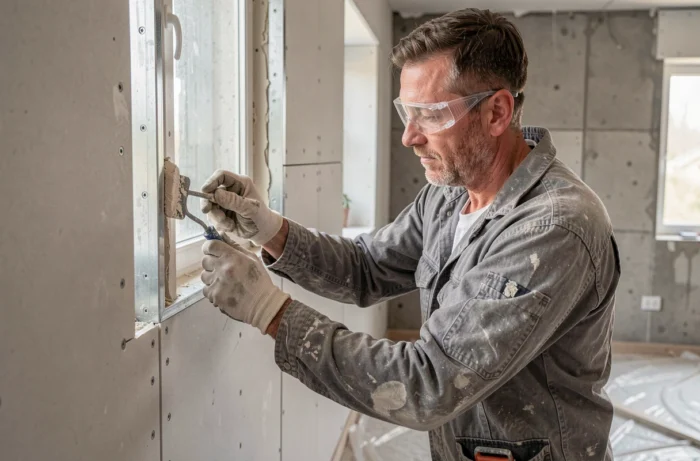
The installation of plasterboard on a window reveal is not just about cutting a board and screwing it in. Several mistakes frequently occur on sites, even among experienced installers.
- Neglecting the metal framework on the reveal: without properly fixed tracks or furring, the board moves and the joints crack within a few months, especially on reveals exposed to temperature variations
- Forgetting to treat the thermal bridge between the window frame and the cladding: an uninsulated gap of a few centimeters is enough to create a cold zone conducive to condensation
- Using standard BA13 in humid areas (bathroom, kitchen) instead of a water-resistant board, which causes swelling of the plaster in the medium term
- Not adhering to the DTU 25.41 specifications regarding fastening distances and joint treatment, which compromises the mechanical integrity of the whole
The DTU 25.41 precisely regulates dry plastering work. It defines the rules for fastening, spacing of screws, and joint treatment. A window frame not compliant with the DTU may be rejected during a compliance check, particularly during a site acceptance in new construction.
Formwork without tracks: a false good idea
Some online tutorials suggest creating a plasterboard formwork around the window without a metal framework, by directly gluing the boards. This method may work on a perfectly flat and stable wall. However, on an old irregular wall, direct gluing without tracks causes visible misalignments once the paint is applied.
The framework (tracks and studs or furring) allows for correcting the support defects and integrating the insulation into the thickness of the cladding. The additional material cost remains modest compared to the gain in durability and flatness.
Finish and customization: the advantage of plasterboard over PVC
Plasterboard offers a surface that accepts all interior finishes: paint, decorative plaster, wallpaper, tiling in humid areas. In contrast, PVC cladding limits the homeowner to a narrow choice of colors and textures, generally smooth white or wood imitation.
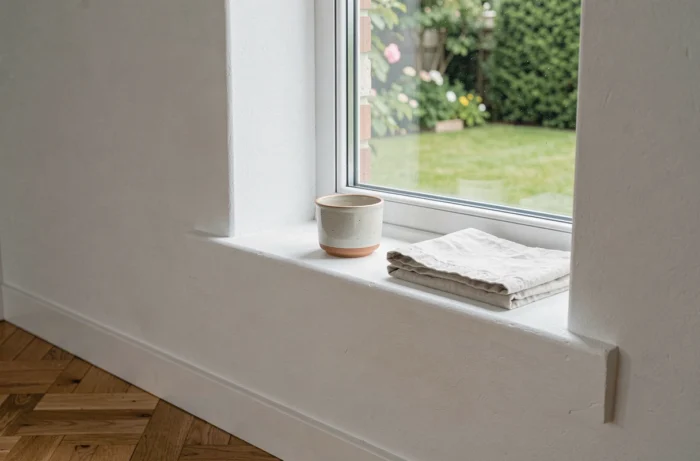
Aesthetically, plasterboard allows for creating a window reveal perfectly aligned with the rest of the wall. The visual continuity between the wall cladding and the bay framing disappears, resulting in a more refined appearance than added PVC profiles.
This visual homogeneity explains why interior designers favor plasterboard for renovations where clean lines and a contemporary style are sought.
The choice between plasterboard and PVC ultimately hinges on two measurable criteria: the ability to insulate the window reveal (clear advantage for plasterboard with insulating complex) and the freedom of finish. The timeline for the removal of CEE aids adds a financial dimension that homeowners in the planning phase would be wise not to ignore.