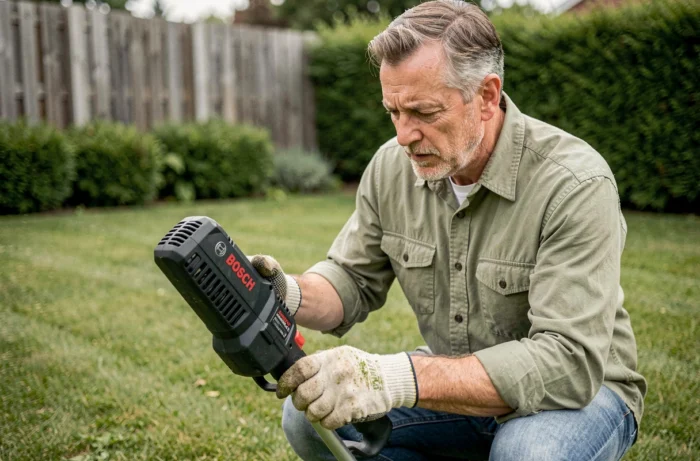
The Bosch AdvancedGrassCut 36 uses a dual-line spool system that requires a 1.5 mm diameter line in double strands of 3.0 m each. Confusing this format with that of an ART model or an earlier generation remains the primary cause of jams after reassembly. Here is the complete method, from disassembly to testing the line output.
Winding Direction and Compatibility of the AdvancedGrassCut 36 Spool
The line that refuses to come out after a replacement usually comes from being wound in the wrong direction or an unsuitable diameter. On the AdvancedGrassCut 36, the spool has a molded arrow indicating the direction of rotation. Winding the line in the opposite direction causes a progressive tightening that blocks the output from the very first seconds of operation.
We recommend checking the arrow on the spool before each reload, even if the handling seems familiar. A line of 1.6 mm or more gets stuck in the output eyelets designed for 1.5 mm. Conversely, a line of 1.3 mm vibrates too much and breaks prematurely.
The technical manual details the step-by-step procedure to change the line of the Bosch AdvancedGrassCut 36 with diagrams of the spool and the exact winding direction.
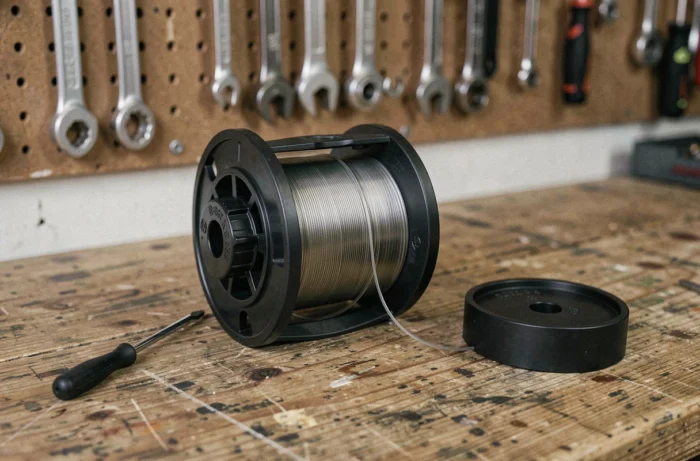
Cleaning the Hub Before Reassembling the Spool
Recent maintenance guides emphasize a step that most users overlook: cleaning the hub and the inside of the casing before reassembling the spool. After several uses, grass and melted line residues accumulate in the housing. This deposit forms an abrasive ring that hinders the free rotation of the spool.
The cleaning procedure is simple but non-negotiable for reliable operation.
- Remove the 36 V battery before any intervention on the cutting head casing, in accordance with Bosch safety instructions.
- Unclip the spool cover by pressing on the side tabs, then remove the spool from its central axis.
- Scrape the residues of melted line from the hub and the internal walls with a non-metallic tool (plastic spatula, used toothbrush) to avoid scratching the guiding surfaces.
- Check that the line output eyelets are not blocked by a fragment of melted nylon. A toothpick is sufficient to clear a partially clogged eyelet.
A dirty hub prevents the spool from turning on its axis when the feed mechanism hits the ground. The line then remains stuck inside, even if the winding is correct.
Dual-Line Winding Technique on the AdvancedGrassCut 36
The spool has two holding notches and two separate channels. Each strand of line occupies a distinct channel. Mixing the two strands in the same channel creates an overlap that causes a knot at the very first rotation.
Installing New Line
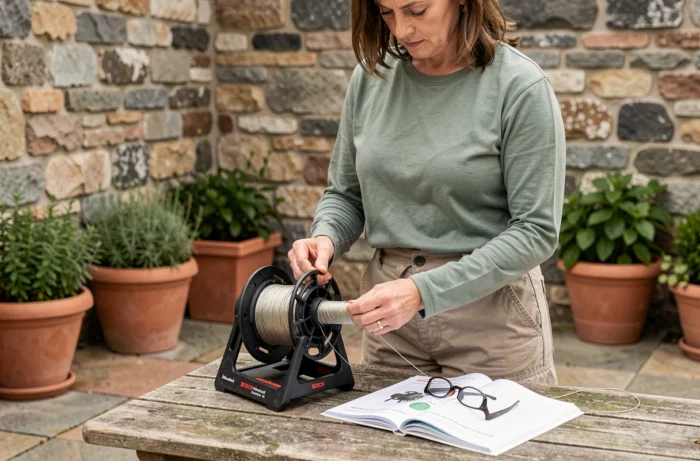
Cut two identical lengths of round nylon line of 1.5 mm. Insert the end of each strand into its respective locking notch, then wind following the molded arrow on the spool. Maintain a steady tension during winding: loosely wound line forms loops that overlap and jam the output.
Leave about a hand’s length of each strand protruding before placing the spool back in the casing. Pass both ends through the output eyelets, then push the spool onto its axis until it clicks.
Reassembling the Cover and Checking
Align the cover notches with the lugs of the casing. Press firmly until you hear a double click. A poorly clicked cover can detach during operation and throw the spool, which poses a real risk.
Manually pull on both strands to check that they slide freely. If one of them resists, disassemble again and check for any overlap in the channels.
Common Mistakes and Diagnosis of Line Not Coming Out
The most common field problem after a reload is a line that remains stuck inside the head. Three causes cover almost all situations.
- Incorrect line diameter: a line that is too thick does not pass through the eyelets, while a line that is too thin breaks flush with the head. The required format remains 1.5 mm, in round section.
- Reverse winding direction: the line tightens instead of unwinding when hitting the ground. Always check the directional arrow on the spool.
- Residues in the hub: even a thin deposit of melted nylon is enough to seize the rotation. The cleaning described above resolves this issue in most cases.
If the line still does not come out after checking these three points, inspect the condition of the output eyelets. A worn or ovalized eyelet no longer guides the line correctly. In this case, replacing the entire cover is necessary.
Choosing Compatible Replacement Line
The spare parts listed for the AdvancedGrassCut 36 indicate a dual-line format of 1.5 mm x 2 x 3.0 m. This format corresponds to two strands of three meters each, pre-cut or to be cut from a roll.
The standard round line is suitable for trimming edges on traditional grass. For tall grasses or tough weeds, a serrated line of the same diameter improves cutting efficiency, provided that the section remains compatible with the output eyelets. We advise against square or star-shaped lines on this model: their wider section forces the eyelets and accelerates wear on the cover.
Storing the nylon line in a cool, shaded place prolongs its flexibility. A line stiffened by aging breaks more easily and winds poorly on the spool, increasing the risk of jamming within the first minutes of use.