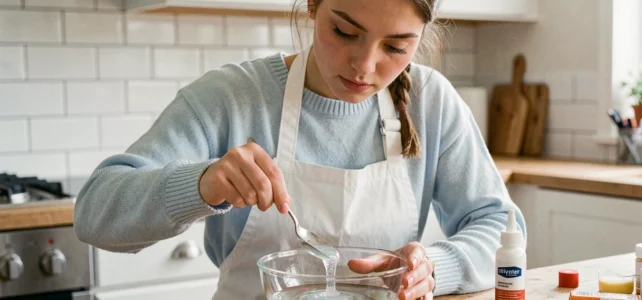
Thickening a slime that is too runny first requires identifying what went wrong with the measurements. Not all thickeners produce the same result depending on the base used (PVA glue, starch, shower gel), and some additions worsen the problem instead of correcting it. This article compares the main correctors available, their measurable effects on consistency, and the precautions to know before using them with children.
Activators and thickeners for slime: comparison by base type
The choice of a thickener directly depends on the initial recipe. Adding cornstarch to a PVA glue and saline-based slime does not produce the same effect as adding that same starch to a glue-free slime.
| Thickener | Compatible base | Mode of action | Result on texture |
|---|---|---|---|
| Saline solution (contact lenses) | PVA glue + baking soda | Polymer cross-linking (boric acid) | Firm, elastic, non-sticky |
| Cornstarch (Maïzena) | Shower gel, toothpaste, glue-free | Absorption of free water | Pasty, less elastic, dries quickly |
| Shaving foam | PVA glue + activator | Volume addition through microbubbles | Fluffy, light, loses volume in a few hours |
| Baking soda | PVA glue + saline solution | Reaction with the boric acid in the solution | Sets quickly, risk of over-thickening |
| Guar gum | Water + dye (natural slime) | Gelation through polysaccharide hydration | Viscous, stretchy, non-toxic |
The saline solution for contact lenses remains the most versatile activator for glue-based slimes. Starch, on the other hand, only works well on glue-free recipes, where it compensates for excess liquid through simple absorption.
Knowing how to thicken a slime that is too runny involves this prior identification of the base: applying the wrong corrector turns a salvageable slime into unusable dough.
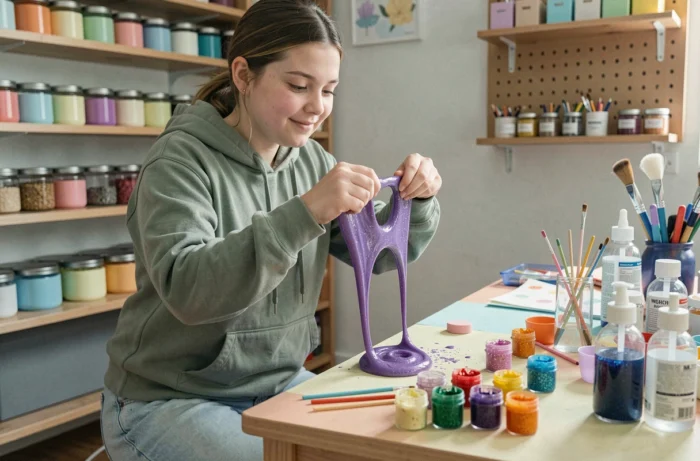
Cornstarch vs saline solution: two very different mechanisms
The confusion between these two thickeners is the main source of failures. Their modes of action have nothing in common.
Starch absorbs, it does not cross-link
Cornstarch acts like a sponge: it captures the free water present in the mixture. Added in small amounts (one teaspoon at a time), it gradually thickens a shower gel or toothpaste-based slime. Mix after each addition and wait one to two minutes before adding more.
An excess of starch makes the slime crumbly and impossible to stretch. The texture becomes sandy and loses all elasticity. For glue-free recipes, this is the main pitfall.
The saline solution creates chemical bridges
In a PVA glue-based slime, the boric acid in the saline solution forms cross-links between the polymer chains. This cross-linking process gives the slime its characteristic elasticity. Add the solution drop by drop: half a teaspoon is often enough to transform a runny slime into a workable dough.
Baking soda amplifies this reaction. If your glue-based slime lacks structure after adding saline solution, a pinch of baking soda significantly speeds up the setting.
Slime too runny: the most common dosage errors
Most failed slimes do not come from a bad ingredient, but from the wrong order or ratio. Three errors dominate.
- Pouring all the activator at once instead of proceeding with small successive additions. Cross-linking is quick and difficult to reverse: a slime that is too firm is much harder to salvage than a slime that is too runny.
- Adding water or liquid food coloring after activation. Each additional milliliter of water dilutes the formed bonds and softens the dough. The dye should always be incorporated before the activator.
- Using overly diluted or expired PVA glue. Low-quality school glues sometimes contain more water than polymer, limiting the cross-linking capacity, regardless of the amount of activator added.
If your slime remains liquid despite several additions of activator, the glue is likely the culprit. In this case, add fresh PVA glue directly instead of continuing to increase the saline solution dose.
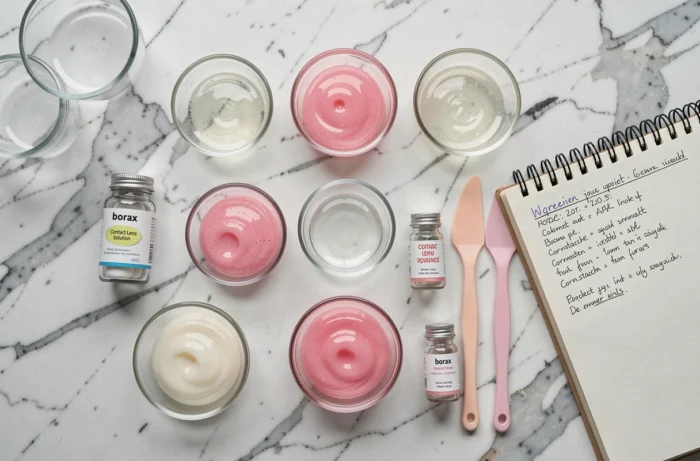
Borax and slime for children: what European regulations say
Borax (sodium tetraborate) is among the most cited activators in English-language tutorials. In Europe, the situation is different.
Borax is classified as reprotoxic category 1B in the European Union, which imposes usage restrictions for the general public. This classification, in effect since 2010, directly concerns creative workshops aimed at children.
Skin absorption remains low on intact skin. However, damaged skin or mucous membranes significantly increase the penetration of boron into the body. Current recommendations for slime activities in family settings are clear:
- Prefer alternative activators: saline solution for contact lenses, liquid starch, guar gum.
- If borax is nonetheless used, wear gloves and avoid any contact with damaged hands or cuts.
- Never allow a child to put slime containing borax in their mouth.
Official recalls of commercial slime products have occurred in Europe due to excessive boron migration, confirming that the risk is not limited to homemade recipes. Store-bought kits can also exceed regulatory thresholds.
Shaving foam and shower gel: emergency thickeners to use with caution
Shaving foam thickens a PVA glue-based slime by incorporating microbubbles of air. The result, called fluffy slime, gains in volume and lightness. Add two to three pumps of foam, then mix vigorously.
The volume obtained decreases by half within a few hours as the bubbles escape. Therefore, this is not a sustainable solution for slime intended to be kept for several days.
Shower gel, on the other hand, serves more as a lubricant. It reduces stickiness without truly thickening. Mix a dollop into a slime that sticks to fingers, but don’t count on it to salvage a runny slime.
The choice of thickener is always conditioned by the base of the slime. Before adding anything, identify your initial recipe, then refer to the comparison table to select the appropriate corrector. A failed slime can almost always be salvaged, provided you intervene with the right ingredient, in the right order, and in small doses.